
The Hot 100’s Recurrent Rules, Explained
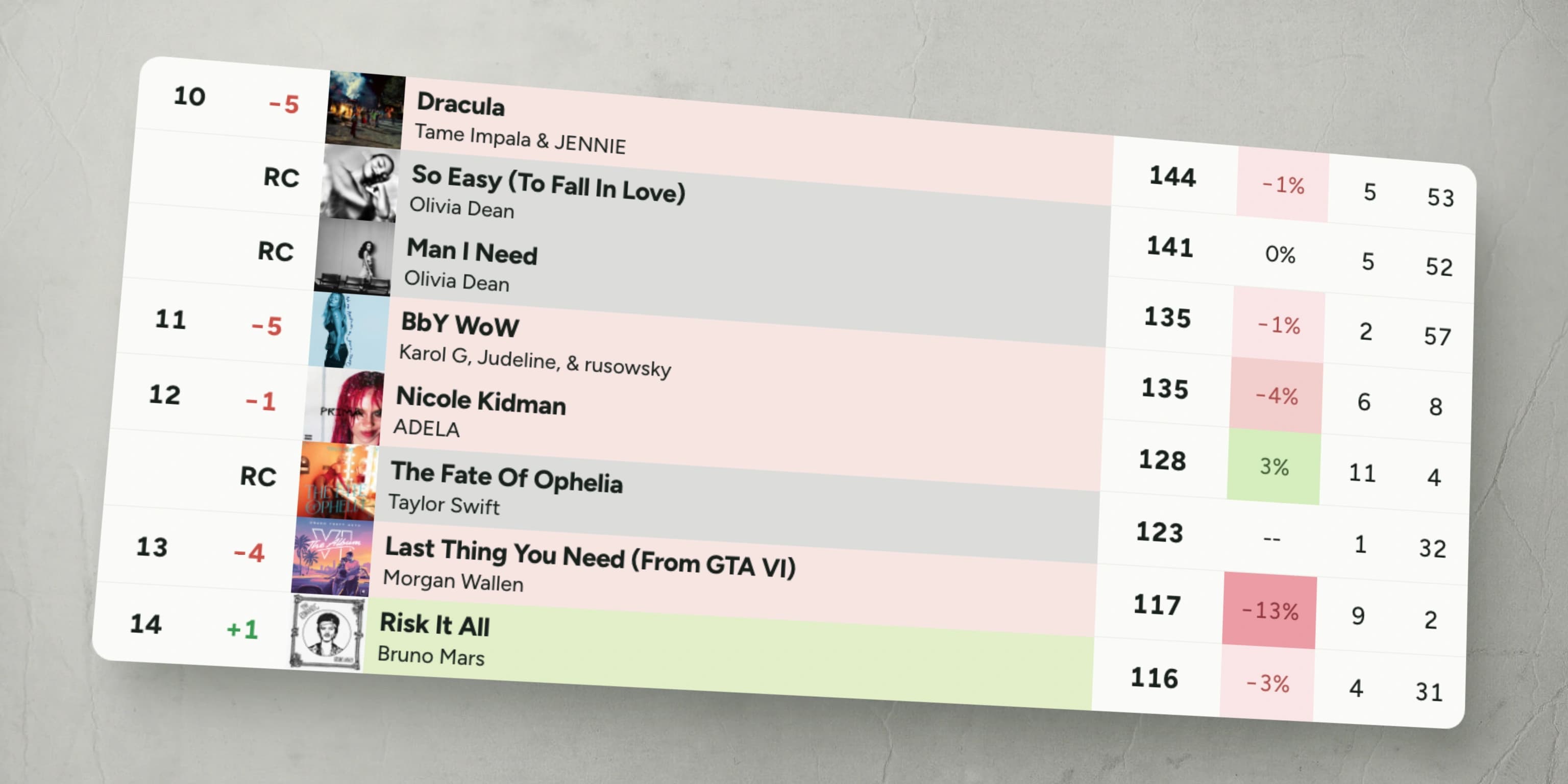
If you follow the Hot 100, recurrent rules can seem like a mystery. Songs seem to be denied re-entry despite being above their thresholds, while others stay for weeks below the cutoffs that should apply to them. We too sometimes get these calls wrong in our Final Predictions.
In this guide, we’ll explain our current understanding of the rules and how they’ve changed. Since we aren’t Billboard, there are still gaps in what we know, especially when it comes to exceptions.
How it started
A “recurrent” is a hit that a radio station still plays after it has moved out of its current music rotation. Mediabase, for example, moves songs to recurrent status under its own rules by removing them from its current song charts even while they still receive airplay.
The Billboard Hot 100 uses the same general idea to make room for newer hits. Going recurrent removes an older song from the chart even if it still has enough streams, sales, and airplay to earn a place. This keeps the chart fresher and more “hot.”
For its first 33 years, the Hot 100 had no recurrency system. It combined sales reports from record stores with airplay reports from radio stations, but those airplay reports could leave out older songs that stations were still playing.
That changed on November 30, 1991, when Billboard switched to monitored airplay and electronically tracked sales. Older hits now received credit for spins that previously went unreported, so they could stay on the chart much longer. Billboard introduced a recurrent rule to make room for newer songs as a result.
The first rule was strict: songs left after 20 weeks once they fell below the top 20, and Billboard moved them to a separate Hot 100 Recurrent Singles chart. Shortly after, in January 1992, the cutoff was made more lenient and changed to #40, and by spring 1992 it had settled at #50. The 20 week/#50 tier remains part of the rules today.
The 2015 and 2025 changes
Under the 20 week rule, a song could keep charting indefinitely as long as it stayed in the top 50.
As we transitioned into the streaming era, some hits had very long runs. To limit those runs, Billboard added another cutoff starting with the chart dated December 5, 2015, removing descending songs below #25 after 52 weeks. One of the first hits affected was Mark Ronson’s “Uptown Funk,” featuring Bruno Mars, which left the December 19 chart after an initial run of 55 weeks.

As digital sales declined and streaming became the dominant metric on the Hot 100, repeat listening helped hits stay on the chart longer.
By late 2025, the situation had become hard to ignore. Teddy Swims’ “Lose Control” had become emblematic of how repeat listening could keep older hits near the top of the chart for what felt like forever. By the time it was removed, “Lose Control” had spent 80 weeks in the top 10 and 112 weeks on the Hot 100, both records.

In response, Billboard added 26 and 78 week cutoffs and tightened the 52 week cutoff to the top 10, citing repeat streaming and radio holding onto hits for longer. The new rules took effect with the chart dated October 25, 2025.
| After this many weeks | Removed if descending below |
|---|---|
| 20 | #50 |
| 26 | #25 |
| 52 | #10 |
| 78 | #5 |
Ten songs were removed under the new cutoffs on that first chart. Going recurrent also removes a song from Billboard’s all-format Radio Songs chart at the same time. Its airplay is still tracked, and it can remain on individual format charts, which have their own recurrent rules.
What counts as “descending”?
Billboard says it considers whether songs are descending “on a case-by-case basis”.
In practice, gains on major radio formats appear to be the primary reason a song is allowed to stay below its cutoff. Based on our tracking, a song can be treated as descending when its airplay is declining across its major formats, even if streams and sales increased that week.
Songs gaining radio spins while being actively promoted on a major format have been allowed to stay, even when they lose substantial sales and streams in a given week (including when their overall chart points decline). Gaining slightly in overall airplay is typically not enough to stay on though; based on our tracking, the actual number of spins gained, and which formats the gains are occurring on, matter.
Streaming or sales gains appear to need a notable event accompanying them, such as a film placement or a major performance, for a song to avoid recurrency if airplay is declining.
Country singles often benefit from radio being the relevant decider of ‘currency,’ because they can take the better part of a year to climb country radio. Shaboozey and Jelly Roll’s “Amen” and Morgan Wallen and Post Malone’s “I Ain’t Coming Back” both spent months below their applicable cutoffs as their country airplay grew.
Re-entering after going recurrent
Going recurrent moves a song into a semi-permanent state of removal, so getting back on can be difficult. Having enough activity to earn a place doesn’t automatically make it eligible again.
A song building on a major radio format can be allowed back below #50 even after passing the 20 week cutoff. “Amen” had spent 22 weeks on the Hot 100 before leaving, then returned at #88 on October 25, 2025. “I Ain’t Coming Back” had also spent 22 weeks on the chart before leaving, then returned at #98 on November 8. Each return was the song’s 23rd chart week, and both were gaining at country radio.
For an older catalog hit returning on the strength of streams or sales, Billboard looks for “a meaningful reason” for its resurgence. That can bring a song back decades after its release, but a routine weekly gain is not enough on its own.
If you’ve followed the chart for a while, you’ll recognize some of the reasons songs come back:
-
Christmas. Billboard explicitly allows holiday classics and newly surging non-holiday catalog songs to return above #50 regardless of their accumulated chart weeks. The recurrent cutoffs apply again as those songs decline, as explained in its October 2025 update.
-
TV and film. Kate Bush’s “Running Up That Hill” re-entered at #8 in 2022 after ‘Stranger Things.’

Sadie Sink as Max in ‘Stranger Things 4.’ Image credit: Netflix. -
Super Bowl halftime shows. Usher’s “Yeah!” (2024), Kendrick Lamar and SZA’s “All The Stars” (2025), and Bad Bunny’s “Tití Me Preguntó” (2026) all came back.
-
Holidays. “Thriller” regularly returns around Halloween, and Toby Keith’s “Courtesy Of The Red, White And Blue” hit a career-best #11 after July 4 this year.
-
After Christmas. Every December, Christmas music pushes current hits below their cutoffs, and many return in January. “Lose Control” missed a single week this way and returned at #4 on January 11, 2025.
Complications with re-entry
Album releases are one of the most inconsistent reasons for re-entry.
Some songs that had already gone recurrent and weren’t gaining on radio have returned when their parent albums came out.
Allowed back:
- Post Malone and The Weeknd’s “One Right Now” had spent 26 weeks on the chart, last appearing at #37. After four weeks off, it returned at #34 in its 27th chart week with Post Malone’s ‘Twelve Carat Toothache’ in June 2022.
- Megan Thee Stallion and Dua Lipa’s “Sweetest Pie” had spent 20 weeks on the chart, last appearing at #49. After two weeks off, it returned at #49 in its 21st chart week with Megan’s ‘Traumazine’ in August 2022.
Not allowed back, despite an album boost:
- Justin Bieber’s “Holy,” featuring Chance the Rapper, didn’t return with ‘Justice’ in 2021, despite being predicted around the top 25.
- Lil Uzi Vert’s “Just Wanna Rock” didn’t return with ‘Pink Tape’ in 2023, despite being predicted around the top 40.
- Taylor Swift’s “The Fate of Ophelia” stayed off when ‘The Life of a Showgirl: The Encore’ arrived in September 2026, despite our predictions putting it around #13.
‘The Encore’ was a deluxe release, but the Bieber and Uzi examples involved the albums’ initial releases.
Older songs with short chart runs
Some original ‘The Life of a Showgirl’ tracks weren’t allowed back with ‘The Encore,’ even though they hadn’t charted long enough to go recurrent. We suspect an age restriction for tracks without an active radio push, possibly after 26 weeks, but haven’t confirmed the cutoff.
Billie Eilish’s “The Greatest” doesn’t fit that pattern, however. It returned at #93 on February 22, 2025, when it was 40 weeks old, with only four earlier chart weeks and zero airplay recorded in our archives. Her FireAid performance of the song on January 30 and Grammy appearance on February 2 may have helped, but both came before the February 7-13 tracking week, so the connection is unclear. Billboard may also have considered its four chart weeks too few to count as significant chart history, but it hasn’t explained the return, which came before the October 2025 update.
Catalog songs with little or no chart history
A song’s chart history also affects where it can enter, because Billboard makes allowances for older songs that haven’t had a substantial chart run. Its October 2025 update says older catalog songs without significant chart history can debut at any rank, so an old song that never charted can qualify without reaching the top 50. Billboard decides each case individually and doesn’t specify how many chart weeks count as “significant.”
Coldplay’s “Sparks” had never charted on the Hot 100 before it debuted at #93 on June 28, 2025 after going viral. It had been released on ‘Parachutes’ in 2000, so it was 25 years old by the time of its first entry.
An element of luck
The stricter cutoffs also make timing matter more than before. A big album release can push an older hit below its cutoff for a single week, and once it’s recurrent, a rebound the following week doesn’t automatically bring it back.
Taylor Swift’s “The Fate of Ophelia” last charted at #14 on May 23, 2026, after 32 chart weeks. It disappeared the following week, when Drake’s new albums put 42 songs on the Hot 100. It had passed the 26 week mark, so a single declining week below #25 was enough to end its run.
Alex Warren’s “Ordinary” also disappeared from the May 30 chart after being #6 the previous week. It had been climbing our modeled all-time ranking quickly and, with a longer run, might have challenged for the top spot.
That has consequences for decade-end and all-time rankings built from Hot 100 performance. A recurrent song stops adding to its chart record even if people keep listening, so the missing weeks can lower both its eventual score and its contribution to an artist’s greatest-of-all-time ranking.